

 By
By By Tiffany Xu
A decade and more has passed since implementers have sought the fruition of a megadam structure by the Jalaur River — unheeding of threats on nature, culture, and life. Soon, the Pan-ay River Basin may not be spared from the grasps of yet another bout of displacement of the Tumandok indigenous community.
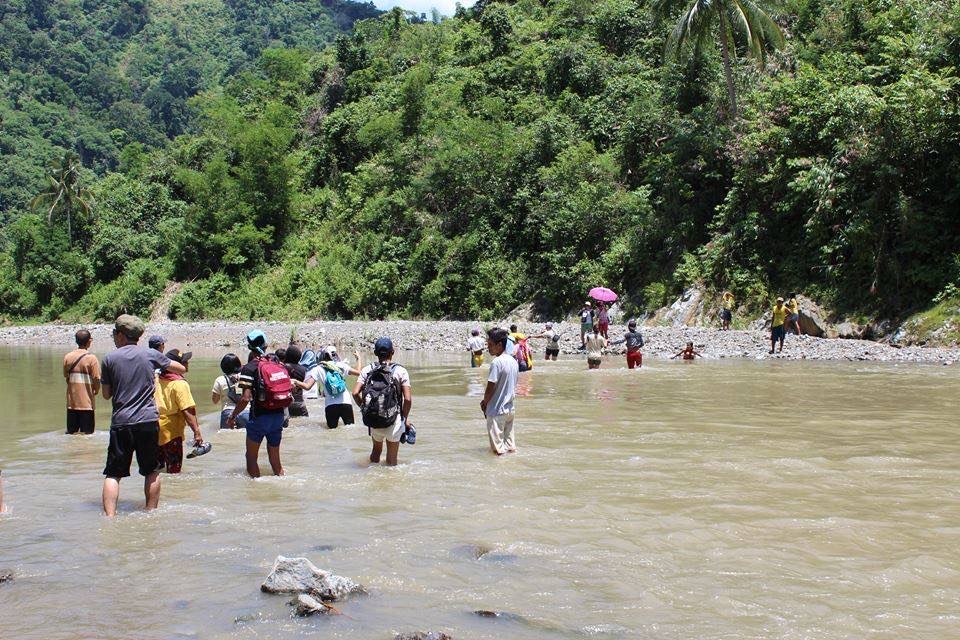
Pre-dam realities: Tumandok people go to great lengths crossing the Jalaur River in their every journey. © Tumandok of Calinog
Inasmuch as the headwaters of Jalaur River are stained, the subsoils of its nearby mountain ranges are also fertilized with the blood of Tumandok dwellers for defending ancestral domains. Hence the #Tumandok9 massacre last December 30, 2020 grimly recounts once more, the indelible link between indigenous resistance and the state’s embellishment of ‘development’ aggression in its projects.
From the parallels of Jalaur and Pan-ay Rivers
The Pan-ay River Basin, covering 16 municipalities and a city, is deemed as the longest river in Panay Island and the 12th largest river basin in the country. Due to its steep slopes and geography, it is prone to severe flooding, which prompts the proposed Panay River Basin Integrated Development Project (PRBIDP) to present itself as a system of flood-control structures, service roads, hydropower pens, and canals.
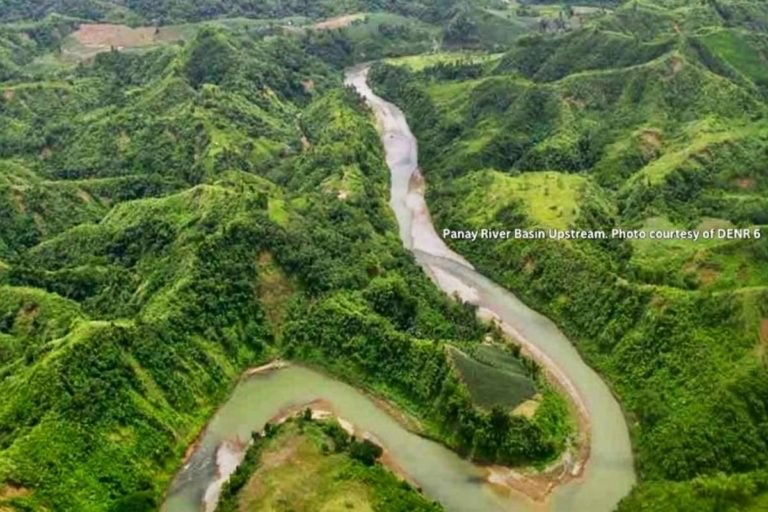
Aerial view of the Pan-ay River Basin. © DENR Region 6
Under the current Marcos Jr. administration, the president himself has given his support by pledging a kickstart fund of P4.5 billion for the big-ticket project. The PRBIDP is among Marcos Jr.’s priority infrastructure progenies across the country that he wishes to see the completion of before his term ends. However, according to the Hong Kong Trade Development Center, there is an expected 6- to 8-year construction timeline upon implementation.

Regional Steering Committee for the Pan-ay River Basin Integrated Development Project (PRBIDP) convening last August 11 for project updates. © PIA Capiz
PRBIDP’s strategy of ‘designing and building as they go’ appears contrary to the goal of merging the architecture and engineering firms into a single venture bid. This comes under the pretext that its initial cost in 2018 ballooned to P20.8 billion notwithstanding the inflation adjustments that may be applied to this year. Moreover, such a proposed budget already surpasses the Stage II cost of the Jalaur River Multi-Purpose Project (JRMP) set at P20.1 billion as of last 2024, which also contains similar key components such as a dam, canal, and hydro-power plant.
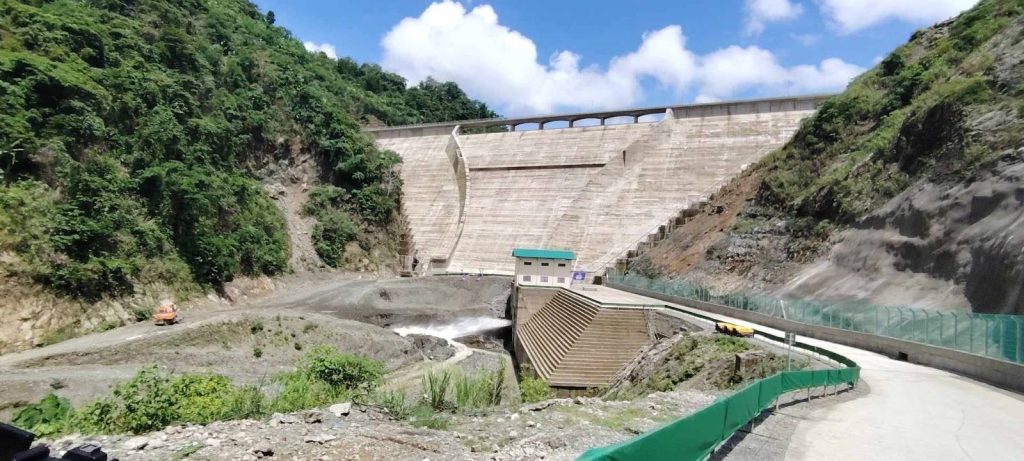
Status of the Jalaur River Multi-Purpose Project (JRMP) Phase II. © Leo Solinap
Just a few of such early warning signs now, draw similarities with the premonitions of researchers previously regarding the Jalaur megadam. It can be recalled, that the controversies correspond to the precarious location of the JRMP situated within the active West Panay Fault, possible disaster in times of earthquakes and flood, and the loss of biodiversity.
National Irrigation Administration (NIA) Region VI Manager and chair engineer for the PRBIDP Steering Committee Jonel Borres also claims that more than 9,000 indigenous people will benefit from the project. A similar tune rings from the words of NIA when they stated that no human rights or environmental policies were violated during the JRMP implementation amid reports of military presence in the project site and the coercive signing of consent forms
Tumandoks in opposition, shortchanged with aggression
As far as history went, the militarization of upland Tumandok communities were long in part a result of vigorously conforming to state interests. In February 1995, the Philippine Army’s 3rd Battalion forcefully evicted the Tumandoks from their land by way of bombs and cannons, stemming from the declaration of then President Diosdado on selected military reserve areas around the country. It was around this time as well, that the onset of talks were underway for the first phase of the Jalaur megadam.
It was almost inevitable that the intensification of Phase II during the early 2000s also manifested correspondingly when picket lines did not go unoccupied in the intent of progressives to echo the plights of the indigenous peoples, especially in the middle of heightening civil-political conflicts.
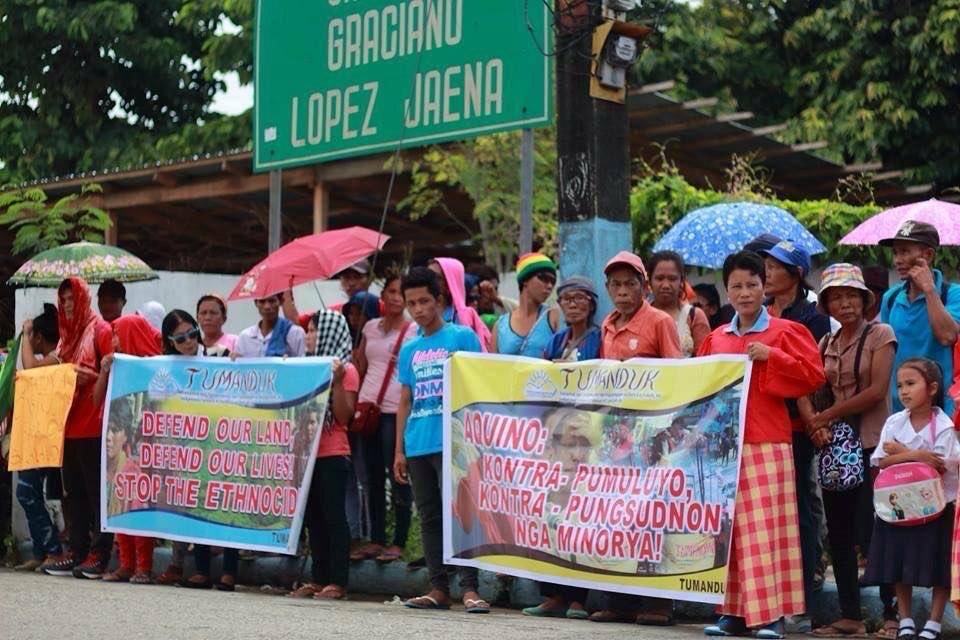
Tumandoks protest in opposition to the Jalaur megadam during the Aquino administration at Iloilo City. © Tumandok of Calinog
Under Rodrigo Duterte’s presidency, the crackdown on dissidents was amplified by his passage of the Anti-Terror Law. Just five months into the year RTL was inked, and at the height of the COVID-19 quarantine, the military dragged nine Tumandok leaders out of their slumber through coordinated operations in Tapaz, Capiz, and Calinog, Iloilo. But before either of them and their family could process what was to happen next, the leaders were already shot dead — the gunshots forever reverberating in the collective memory of the Tumandok people.
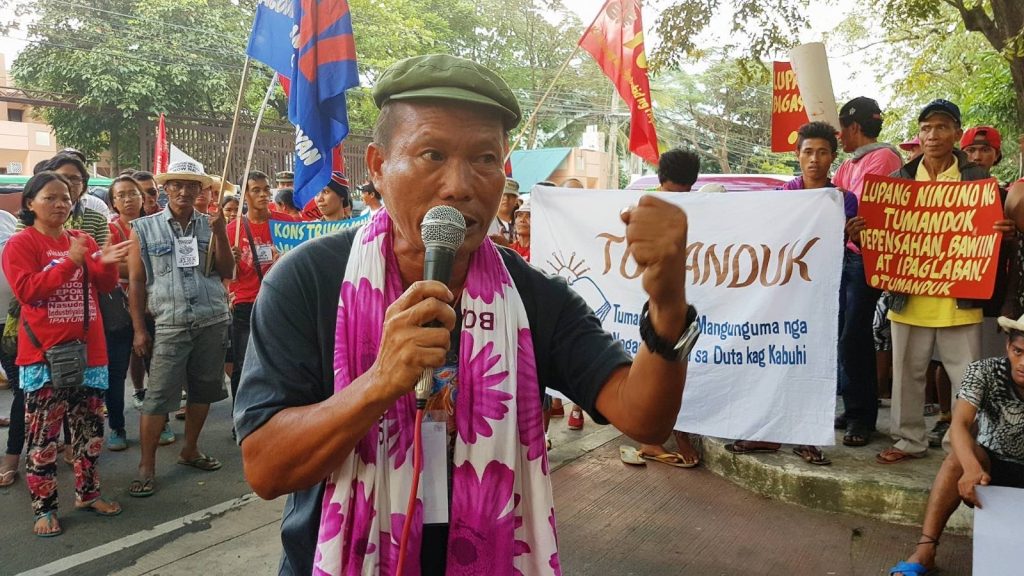
Massacred leader and chairperson of TUMANDUK Roy Giganto delivers a message in the middle of their rally. © Tumandok of Calinog
Despite the harrowing violence entailed, local resistance efforts often do not make its way to front page headlines, radio stations, and the informed minds of the Panayanon folk. But perhaps it is in the very same air of terror that sleepwalks on the resolve of the masses to recognize and assert their rights.
Development aggression is termed as is from the means in which it is enforced to its recipients — aggressive, domineering, exclusive. It may be glamorized into narratives of economic growth, but rarely for the very marginalized sectors and the basic human rights trampled in the process. What is also somber, is that the rich cultural heritage of the Tumandoks becomes selectively romanticized, objectified from the confines of museum exhibits and appropriated forms of content. Issues on land, and self-organization are treated as taboo, almost akin to the haunted folklore that compel you to keep silent about.
Where issues and hope for social movements meet
Yet from the dusk of Tumandoks’ struggles, comes the daybreak of an ever-militant and growing social movement. Grassroots communities and progressive organizations alike that call for justice thus far have assertingly recognized that collective resistance towards minority violence is a due necessity and moral responsibility.
The No to Jalaur Dam movement, led by the Jalaur River for the Peoples’ Movement and its allies, has gone as far as receiving solidarity from Western Visayas bishops and over 150 international and national groups. Additionally, the persisting exposé on anomalous and ghost infrastructure projects this 2025 has eventually led the South Korean government to withdraw its megadam loan agreement with the Philippines. But at the heart of it, the movement is only ever alive with the collective resistance of the Tumandok people.

Jalaur River for the Peoples’ Movement (JRPM) and South Korean civil organizations demanding for corporate accountability, megadam funding, and due justice. © JRPM
As these groups have detailed, the mere aspirations of the Tumandoks lie with just peace, rights to their ancestral domain, and a harmonious coexistence with nature devoid of ecocide. Life to them, is both in their land and culture. Neither rebels nor primitives, they were simple farmers, fishers, and heritage holders with honor. And for as long as these truths and lived realities are inevitably manifested, the Tumandok struggle will also continue to live on with the masses that rally and support behind them./PT