
 By
By By Juliane Judilla
“Buotan na si Tapang [Roger Fabillar].” (Tapang [Roger Fabillar] was a kind person.)
These were the words of alias “L,” a resident of Brgy. Salamanca, Toboso, Negros Occidental, when asked if she could recall the events of April 19, 2026, after a military operation in the same barangay claimed the lives of 19 individuals, including 10 members of the New People’s Army (NPA) and nine civilians, two of whom were minors.
For L, whose identity has been withheld for security reasons, the NPA had consistently helped residents in their struggle to acquire ownership of the lands they had tilled for years.
“Ging buligan ya na kami sa petition para sa titulo sang duta,” she added. (He helped us with the petition for the land title.)
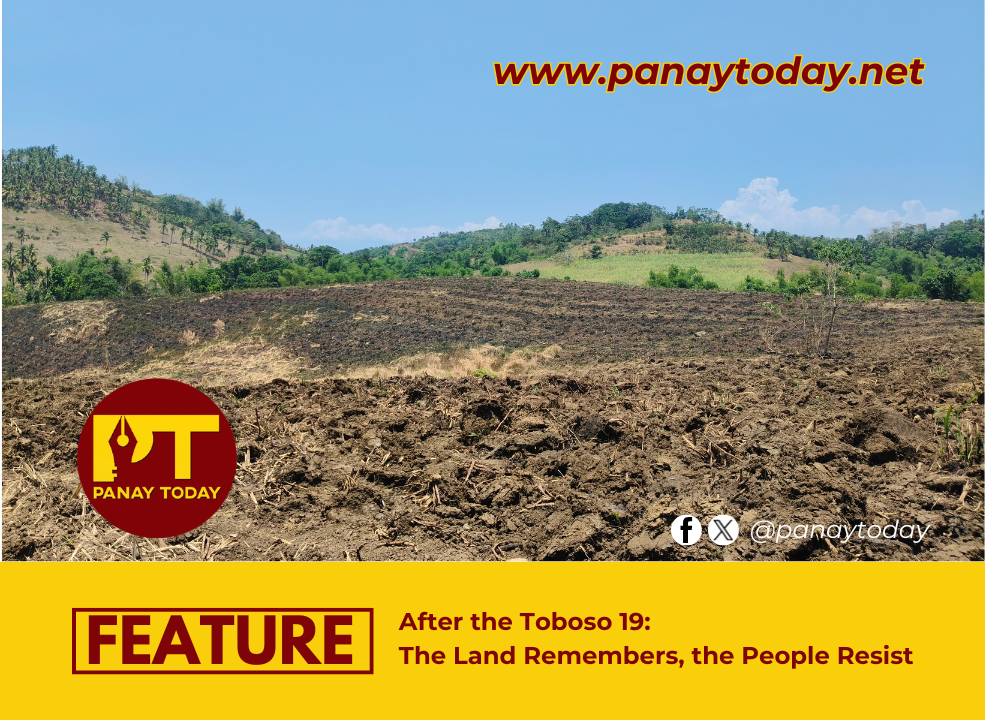
She said they had been cultivating the 18-hectare sugarcane plantation known as Hacienda Bedonia, reportedly owned by the Baynosa family, where she worked as a farm worker during harvest seasons. During the dead season, they planted monggo (mung beans), saging (bananas), and occasionally mais (corn).
After repeatedly traveling back and forth to Manila to process the necessary documents, they eventually secured a land title. Since then, they had been conducting bungkalan or collective land cultivation activities (LCAs), up until February of this year.
NEGROS AND ITS HISTORY OF PLUNGING FARMERS INTO HUNGER
The island of Negros has long stood as a stark image of semi-feudalism. Haciendas, whose origins trace back to the Spanish colonial era, remain deeply embedded across towns dominated by vast plantations owned by a handful of families, yet tilled by workers who earn only a fraction of the wealth they produce.
According to data from the National Federation of Sugar Workers (NFSW), a regional chapter of the Kilusang Magbubukid ng Pilipinas (KMP), approximately 380,000 farm workers, including 18,000 mill workers, earn only PHP 800 to PHP 1,200 per week. The labor system largely relies on “pakyaw” (piecework) payments, where workers receive the same amount despite performing multiple tasks within a single day. This system effectively disregards the Department of Labor and Employment’s mandated minimum wage for agricultural workers, which amounts to PHP 520 for an eight-hour workday. Other labor violations include the non-remittance of Social Security System (SSS), PhilHealth, and Pag-IBIG contributions.
The entire island has already been structured to serve the economic interests of the big landlords in Negros, working in collusion with some of the country’s largest capitalists. Nearly ten of the wealthiest conglomerates in the Philippines now maintain a foothold in Negros. Among them are the Gokongweis, who own the La Carlota Sugar Central, URSUMCO for their food and beverage business, and the Universal Robina Corporation (URC)-SONEDCO operating in Kabankalan City, Negros Occidental, and Bais City, Negros Oriental. Other major conglomerates include the Consunjis, whose interests span construction, water, and agro-industry including the palm oil plantation in Candoni that has displaced hundreds of farmers and indigenous peoples community in the area; the Aboitiz group, involved in water, power, construction, and shipbuilding; the Villars in water and real estate development; the Pangilinan group in water, hospitals, and mining; Enrique Razon in electricity; the Sys through SM malls and banking; the Ayala-Zobel family in malls and real estate; and Lucio Tan, who controls Asian Alcohol in Pulupandan, Tanduay Distillery in Murcia, and holds partial ownership of Victorias Milling Company for his liquor business.
While the majority of farmworkers and farmers live in dire conditions, trapped in a cycle of economic dependency on the sugar industry, century-old monopolies continue to perpetuate poverty. Meanwhile, big corporations exploit the island’s fertile land, while the state blatantly refuses to heed the calls of the most vulnerable sector of society.
Nearly 70% of beneficiaries under the Comprehensive Agrarian Reform Program (CARP) since the administration of President Corazon Aquino have fallen into leasing, mortgaging, or completely selling their awarded lands. According to a 2008 study by the Negros Occidental Provincial Government, 25,336 out of 61,375 Agrarian Reform Beneficiaries (ARBs) in the province no longer owned the lands awarded to them. By 2010, this figure was estimated by the NFSW to have reached at least 70%.
Around 160,000 hectares covered by the Certificate of Land Ownership Award (CLOA) have now been leased out. As of 2019, more than 98,000 hectares, or 57% of agricultural land in Negros Occidental, remained unallocated due to delays in Department of Agrarian Reform (DAR) processes. Under this reactionary government, land ownership for farmers remains an illusion. The land reform program has become a corrupt enterprise that benefits the state and the dominant classes through land conversion and exemption schemes.
In 2020, the Support to Parcelization of Lands for Individual Titling (SPLIT) Project—an initiative of the DAR funded by the World Bank—was implemented to subdivide collective Certificates of Land Ownership Award (CCLOAs) into individual titles for farmers. However, according to farmers’ groups, the program has undermined collective cooperation among farmers, made it easier for foreign corporations to seize land, facilitated the reconcentration and monopolization of land ownership, and harmed the livelihoods and homes of farmers and workers in sugarcane plantations.
The continued implementation of programs under Ferdinand Marcos Jr. and previous administrations—such as land reclassification, land conversion, and land grabbing through inhumane policies—has further worsened the widespread hunger and poverty experienced by farmers. The intentions of the government and the ruling class are clear: to satisfy their greed. The people must continue to resist and oppose the government’s so-called “development” programs, which are driven by the interests of foreign corporations and the local ruling class.
Negros Island remains a bastion of landlordism, where the hacienda system is still deeply entrenched. This is why farmworkers and farmers have conducted several LCAs across the island since 2006, covering more than 100 haciendas.
MILITARIZATION IN THE COUNTRYSIDE
So-called “development” projects have long been tied to intense militarization on the island. However, the presence of state forces has become deeply embedded in communities across the hinterlands of both North and South Negros since time immemorial.
In 2018, Memorandum No. 32 was signed by then-president Rodrigo Duterte in response to the alleged rise of “insurgency” in the provinces of Samar, Negros Oriental, Negros Occidental, and the Bicol Region. Its local implementation on the island, referred to as “Oplan Sauron,” was an intensified joint counterinsurgency and anti-criminality campaign carried out by the Armed Forces of the Philippines (AFP) and the Philippine National Police (PNP) in Negros Oriental beginning in late 2018. The operation deployed additional state troops to suppress what the government described as lawless violence in the Visayas and Bicol regions.
First launched in December 2018, the initial phase focused on serving search warrants for illegal firearms in areas suspected of being influenced by rebel groups. “Oplan Sauron 2.0” was later carried out in March 2019. Simultaneous police and military operations in Canlaon City, Manjuyod, and Santa Catalina resulted in the deaths of 14 farmers. State forces conducted raids primarily to serve search warrants, but authorities claimed that the suspects “fought back” (“nanlaban”), resulting in fatal shootouts.
“Negros has been the massacre capital of human rights and international humanitarian law violations,” said Ariel Casilao, national chairperson of Unyon ng mga Manggagawa sa Agrikultura (UMA).
“I don’t want to say it, but this is what the data shows: remember the Sagay 9 massacre, remember the Fausto massacre, remember the massacres that have happened in the entire island of Negros,” he added.
In the case of Hacienda Bedonia, there are 16 families of farmworkers, including that of L, living on the 18-hectare land now presumed by the Baynosa family. These farmworkers earn only PHP 150 per day, with no benefits or subsidies.
Although the families have long resided on and cultivated the land, they do not legally own most of it. Around November 2025, the Hacienda Baynosa Farmers and Farmworkers Association (HBFFA) was established and conducted research on the legal status of the land. They discovered that no land title was registered with the municipal assessor’s office; only a tax declaration existed. They also found no title records in Iloilo or Bacolod. During this period, the association also began discussing plans to collectively cultivate the land.
After the harvest in December 2025, the farmers informed the leaseholder that they would no longer continue planting sugarcane and that they themselves would begin tilling the land. By February 2026, the land occupation had officially begun. The farmers were able to recover around four hectares of land due to the dry season, and they started planting crops such as mung beans, cassava, sweet potatoes, and other root crops.
In March 2026, the landowner became alarmed after the leaseholder reported the situation, although no immediate action was initially taken. The overseer, or “amistador,” also filed a complaint with the barangay against the 16 families, but the complaint was dismissed because the barangay found no basis for action, as the amistador could not present any land title.
During the second week of April, Baynosa’s grandchildren reported the land occupation to the mayor of Toboso, claiming that the NPA was taking over their land and alleging the presence of armed individuals. These reports reportedly originated from the amistador. As a result, the mayor summoned the 79th Infantry Battalion, and a conference was held at the municipal hall around April 17 or 18.
On April 18, personnel from the 79th Infantry Battalion began deploying to the households, which residents viewed as a form of intimidation and harassment.
THE APRIL 19 BLOODSHED
In the early morning of April 19, L recalled that several members of the military began searching for alleged members of the NPA who had supposedly been “terrorizing” the area.
“Ging tayaan nila [military] pusil akon bana,” she said. (They [the military] pointed a gun at my husband.)
L stated that the military attempted to enter more than 10 houses and harassed residents while asking for the whereabouts of members of the revolutionary group.
Based on accounts from other residents presented in the initial findings of the National Fact-Finding and Solidarity Mission (NFSM) on May 14, 2026, the first gunfire in Sinugmawan was heard as early as 3 a.m. on April 19 and continued intermittently until 7 a.m.
Residents also reported that several drones had been repeatedly hovering over the community in the days leading up to April 19 and even afterward. The continued drone presence caused fear and tension among residents, who believed the aerial surveillance was connected to ongoing military operations in the area.
The operation was followed by a hot pursuit that reached Sitio Plaringding. As early as 9 a.m., residents heard intermittent gunfire coming from the direction of the fishpond in Plaringding, continuing until around noon, 1 p.m., and 2 p.m.
The incident resulted in the deaths of 19 individuals. The Communist Party of the Philippines (CPP) confirmed that 10 of those killed were members of the NPA, including Roger Fabillar, also known as “Jhong” and “Tapang.” The remaining nine were civilians, including University of the Philippines Diliman University Student Council councilor Alyssa Alano, Bacolod-based community journalist RJ Nichole Ledesma, UMA staff member Errol Wendel, peasant organizer Maureen Santuyo, and Fil-Am activists Lyle Prijoles and Kai Sorem.
UMA National Chairperson Ariel Casilao confirmed that the civilians had been in the area conducting research on the agrarian dispute at Hacienda Bedonia when the military operation took place.
THE LAND REMEMBERS
For L and the other residents of Sitio Sinugmawan, as well as the farm workers of Hacienda Bedonia, the massacre once again revealed whose side and interests the state truly serves.
“[Ka]subo nga nadula na ang mga ga bulig sa amon, buot man na sila [NPA]” L added. ([It is] painful that those who helped us are now gone; they [the NPA] were kind as well)
Yet even after the April 19 incident, they continued cultivating the land despite the ongoing harassment and intimidation by the military. They believe the lives of those who stood beside them cannot simply be forgotten. No amount of threats or violence can outweigh the struggle to reclaim the land they have long tilled and called their own
Their struggle is not isolated. Across Negros, the same story has repeated itself for generations. To live in Negros is indeed to know death. The island has witnessed so much bloodshed that one begins to wonder whether blood has made the sugarcane grow sweeter, thicker, or faster; whether loss has become another word for “progress”; whether violence has become synonymous with normalcy; and whether impunity itself has become the island’s unspoken tourism slogan.
It is in the haciendas of Sagay, Toboso, and in the peasant communities of the uplands of Himamaylan, Binalbagan, Kabankalan, and Candoni, that we come to understand violence most clearly. But it is also here that we understand resistance. Negros reveals a truth that continues to endure: wherever there exists a system that kills, there will always emerge a movement that grows, fights back, and reclaims what has been taken.
This truth reveals itself after every massacre, every crackdown, every arrest, and every attack. The blood of those killed seeps into the same soil where the seeds of resistance are planted—the very soil that generations of peasants have fought for and defended. And every single time, resistance blooms stronger where it has been sown./PT
##
(DISCLAIMER: The author was one of the journalists, along with hundreds of delegates, who joined the National Fact-finding and Solidarity Mission (NFSM) in Brgy. Salamanca, Toboso, Negros Occidental, on May 14. The name of the interviewee is withheld for security reasons. Anyone who wishes to quote the interviewee must first seek permission from the author and from Panay Today, so that we can relay it to the proper channels, families, or delegation representatives.)