
 By
By By Juliane Judilla
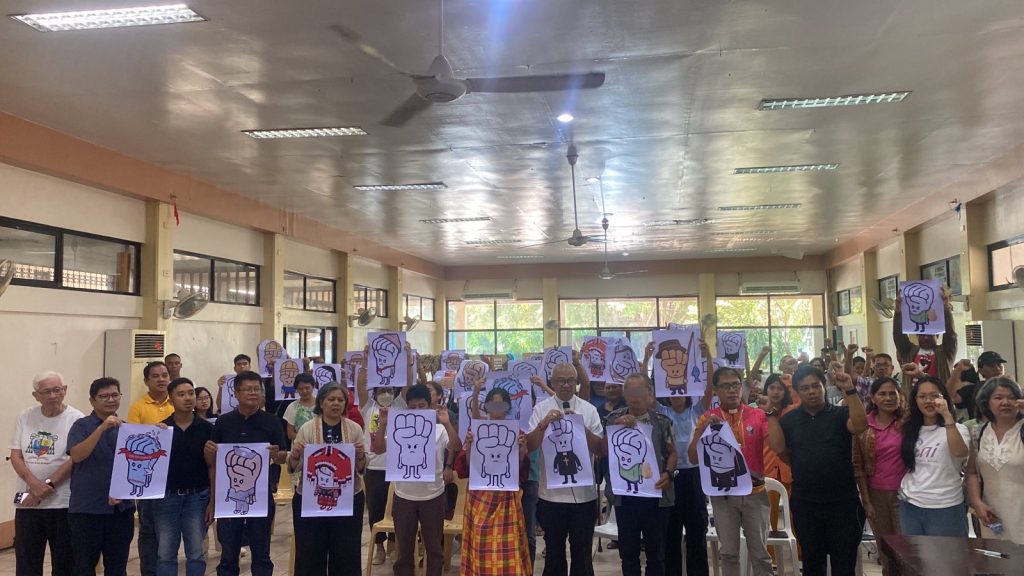
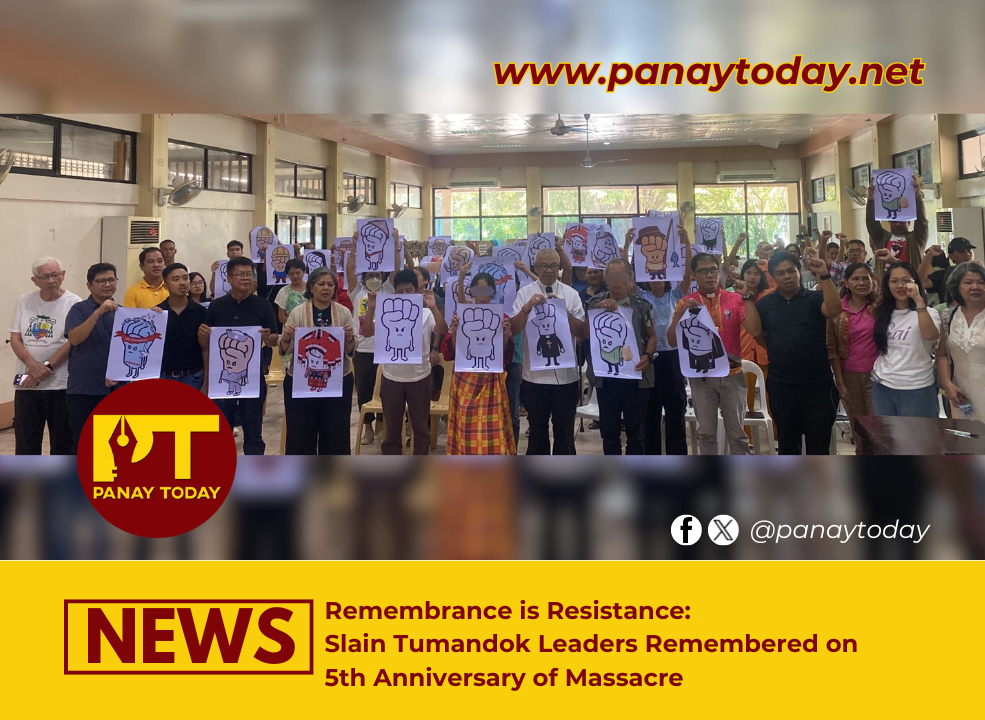
ILOILO CITY — Over a hundred organizations gathered in solemn unity to remember and commemorate the anniversary of the Tumandok massacre, renewing calls for justice, accountability, and an end to militarization of Indigenous communities.
The commemoration marked the fifth anniversary of the December 30, 2020 Tumandok massacre. The activity was led by the Defend Panay Network (DPN) and the Jalaur River for the People Movement (JRPM), together with ecumenical formations, human rights alliances, and multi-sectoral organizations. It was held at St. Clement’s Church in Iloilo City on December 30, 2025.
Participants denounced the killings of Roy “Allan” Giganto, Mario Aguirre, Eliseo “Unol” Gayas Jr., Reynaldo Katipunan, Garson “Galson” Catamin, Maurito “Mauro” Diaz, Jomar Vidal, Rolando “Lando” Diaz Sr., and Artilito “Tali” Katipunan. The nine Tumandok leaders were killed during joint police and military operations in the uplands of Central Panay in the early hours of December 30, 2020, where authorities claimed were based on search warrants but which families and human rights groups have long described as summary executions. The killings were done alongside the arrest of 16 others community members on trumped-up charges.
Denouncing impunity and militarization
Most Rev. Gerardo A. Alminaza, D.D., Bishop of the Diocese of San Carlos and convenor of MANINDIGAN, condemned the massacre as part of a broader pattern of state violence under the administration of former president Rodrigo Duterte. He denounced the continued militarization of rural and Indigenous communities and the entrenched culture of impunity.
“You are not the only communities to experience such suffering and such attacks,” Alminaza said.
“We can all stand together. The Tumandok can share strength by uniting with other communities who have been victims of state brutality and human rights violations,” the Bishop added.
He drew parallels between the Tumandok massacre and earlier and later operations across the country, citing the killings of farmers in Negros in 2018 and 2019 under Memorandum 32, as well as the March 7, 2021 “Bloody Sunday” raids in Southern Tagalog that left nine activists dead.
According to Alminaza, these operations shared a common “tokhang-style” narrative of alleged armed resistance or “nanlaban,” echoing the discredited claims used during the government’s so-called war on drugs.
The Bishop also denounced the attacks on several key persons in the Tumandok case including the killing of one of the case’s potential witnesses, Barangay Captain of Roosevelt, Tapaz, Capiz Julie Catamin, the stabbing attack on the case’s lawyer Atty. Angelo Karlo Guillen, and the subsequent surveillance on JRPM Coordinator John Ian Alenciaga.
International solidarity
International solidarity was also expressed during the program. Korean Transnational Corporations (KTNC) Watch, a network of South Korean civil society organizations monitoring overseas human rights and environmental abuses by Korean companies, sent a message affirming support for the Tumandok people.
KTNC Watch emphasized that the controversial Jalaur Mega Dam Project, which Tumandok communities have long opposed, was funded by the Korean government and constructed by a Korean company. The group criticized continued refusals to acknowledge the human rights violations and environmental destruction linked to the project.
“KTNC Watch stands in solidarity with the Tumandok people in remembering the nine leaders who gave their lives to defend their land, rights, and way of life,” the statement read.
The group reaffirmed its commitment to pursuing justice and strengthening international collaboration, recalling advocacy visits to Korea that highlighted the courage of Tumandok leaders and their supporters.
Culture, memory, and resistance
Members of the Tumandok nga Mangunguma nga Nagapangapin sa Ila Duta kag Kabuhi (TUMANDUK) attended the commemoration despite reports of continued military presence and harassment in their communities.
Former political detainee, martial law survivor, and activist Adora Faye De Vera formally launched a portion of the translated version of Lahug’s Gintarangban, an epic chant that narrates the Tumandok people’s history of struggle and resistance. The presentation underscored the role of culture and collective memory in sustaining Indigenous resistance amid repression.
“Our duty to remember”
DPN, in its statement, reminded the public to always “remember” the senseless killings and the blatant ignorance of the state as calls for justice grow only louder with each passing year.
In the statement, DPN reflected on its formation in the aftermath of the massacre, describing the climate of fear that followed the killings. The network recalled how red-tagging, arrests, abductions, and extrajudicial killings had silenced many voices in civil society, making collective action difficult but all the more necessary.
The statement detailed how Tumandok communities had asserted their ancestral land rights, opposed the declaration of their territory as a military reservation, and resisted development aggression—particularly the Jalaur Mega Dam Project.
“Their effective organizing, cultural assemblies, and militant opposition made them targets of a state determined to crush dissent,” DPN said.
The group added that the massacre was preceded by military deployments, intelligence gathering, and the use of fabricated search warrants branding Tumandok leaders as “terrorists.” The December 30, 2020 raids resulted in nine deaths and the arrest of 16 others, leaving families traumatized and communities displaced. Hundreds of Tumandok were forced to flee, many abandoning their ancestral lands and traditional livelihoods.
The network criticized the government’s refusal to ensure accountability, citing the lack of transparent investigations, the withholding of information from the Commission on Human Rights, and internal police probes that absolved perpetrators. Meanwhile, the construction of the Jalaur Mega Dam continued, celebrated by officials as a symbol of “development,” despite being built, DPN said, on stolen land and bloodshed.
“For the government, the story of the Tumandok is an inconvenient memory, overshadowed and even justified by infrastructure projects in the name of ‘development’ and ‘water security.’ For them, that story ended five years ago,” the statement read.
“For the Tumandok, however, it is anything but over,” it added.
To officially cap the activity, all organizations, movements, institutions, and individuals present signed a Declaration of Solidarity with the Tumandok Indigenous Peoples of Panay, pledging to support and defend the Tumandok people’s rights to their ancestral land, self-determination, and cultural integrity; oppose militarization, red-tagging, disinformation, and repression directed against indigenous communities and their leaders; advance truth, accountability, and access to justice, including independent investigations into the Tumandok Massacre; engage in international human rights mechanisms, including the United Nations, to ensure scrutiny, protection, and redress; and to stand in sustained solidarity with the Tumandok and all indigenous peoples resisting land dispossession and environmental destruction.
“Until justice is served for the victims of the Tumandok Massacre, and as long as ancestral lands remain under threat, we commit ourselves to the enduring struggle for dignity, life, and rights,” the Declaration stated.
“For the land, for life, for justice. We stand with the Tumandok Indigenous People,” it added.
Five years after the massacre, the Tumandok people continue to mourn their dead while asserting their right to justice, land, and self-determination. For rights defenders and advocates, the commemoration served as a reminder that remembering the slain is not only an act of mourning, but a form of resistance—one that insists the truth be preserved and the struggle carried forward.