
 By
By By John Ian Alenciaga, Coordinator, Jalaur River for the People Movement (JRPM), August 2025
PANAY ISLAND, PHILIPPINES – For over a decade, the Tumandok people of Panay Island have resisted the Jalaur River Multipurpose Project Phase II (JRMP II), also known as the Jalaur Mega Dam.
Initially budgeted at Php 11.2 billion ($193 million), costs have escalated to over Php 20 billion ($345 million), with Php 11.56 billion ($199 million) financed through a tied loan from South Korea’s Export-Import Bank (KEXIM) via the Economic Development Cooperation Fund (EDCF). In 2024, an additional Php 7.088 billion ($122 million) in “unprogrammed funds” was added, raising concerns about fund misuse and lack of transparency.
Constructed by Daewoo Engineering and Construction, the project affected Tumandok people in Calinog, Iloilo, whose ancestral lands are being inundated and militarized. The site’s proximity to the West Panay Fault, a highly active seismic zone, heightens fears of disaster and massive flooding in downstream communities.
Resistance in the Face of Repression
The Jalaur Mega Dam has led to forced displacement, desecration of ancestral lands, destruction of the environment, and loss of livelihoods for the Tumandok. Beyond material impacts, the project erodes centuries-old traditions and cultural heritage, disrupting ways of life intimately tied to the land and rivers of Panay.
From the outset, the project violated the right to Free, Prior, and Informed Consent (FPIC). Villagers resisting the project were subjected to threats, harassment, and intimidation, reinforced by the militarization of communities.
The repression peaked on December 30, 2020, when nine Tumandok leaders were killed and sixteen others arrested during a joint military-police operation. Branded as counterinsurgency, the operation was in fact aimed at suppressing opposition to the dam.
Despite these acts, Tumandok communities continue to resist. They face military exercises, disruption of solidarity, and ongoing violations of freedoms of association and organization. Their resistance persists, rooted in collective strength, shared conviction, and the belief that no dam can be imposed through bloodshed.
Holding KEXIM Bank and Daewoo Accountable
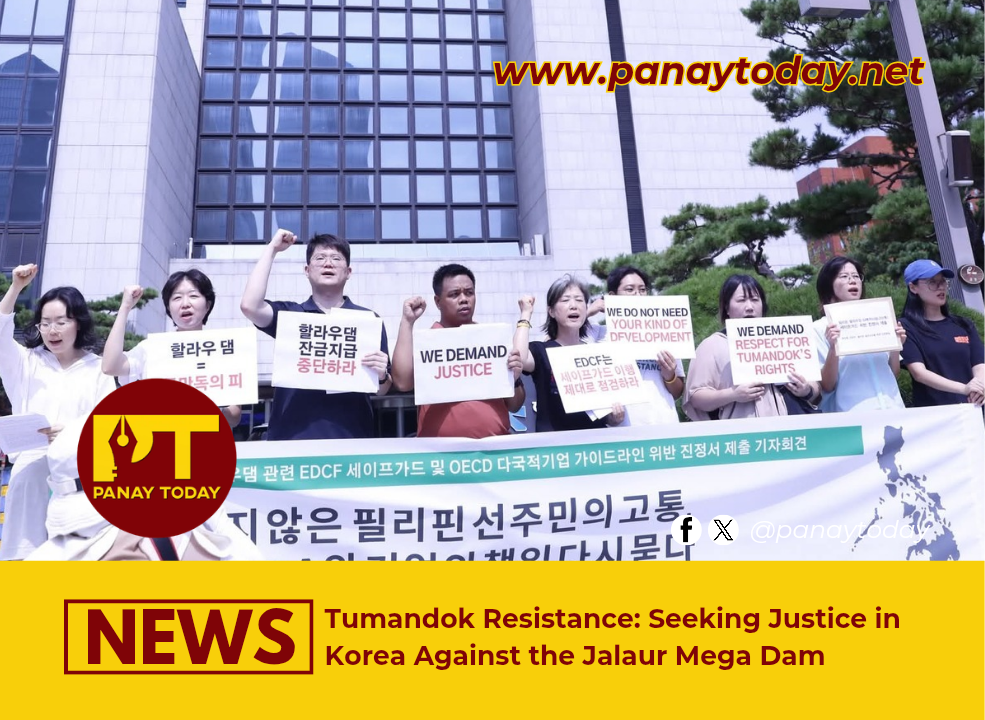
In August 2025, JRPM, Tumandok communities, and Korean civil society allies filed two historic complaints in South Korea: one to the EDCF’s Human Rights Management Committee and another to the Korean National Contact Point (KNCP) for the OECD Guidelines on Multinational Enterprises. These filings aim not just to seek redress but to challenge the model of “development” imposed on Indigenous lands for profit-driven mega-projects.
The EDCF complaint targets grave breaches of safeguard policies and human rights obligations. These include the failure to avoid and mitigate impacts, the absence of genuine consultations, violations of FPIC, surveillance, harassment, red-tagging, extrajudicial killings, arbitrary arrests, environmental destruction, and displacement of Tumandok families. By bringing these violations to the EDCF, the Tumandok assert that development must be measured not by dams or returns, but by human dignity and survival.
The KNCP complaint addresses post-2018 harms during and after construction: displacement, biodiversity loss, and militarization of villages. It emphasizes that Korean companies like Daewoo have responsibilities beyond compliance with Philippine law or contracts. As multinationals, they are bound by international standards of responsible conduct, including human rights and environmental protection. By filing the case in Korea, the Tumandok insist that home-state accountability is essential: corporate responsibilities do not end when construction finishes but extend to remedying harms inflicted.
Expanding the Terrain of Struggle
International mechanisms like the EDCF Human Rights Management Committee and the KNCP are limited: they are slow, politically constrained, and cannot directly enforce findings. Yet, engaging them expands the terrain of struggle. By entering these formal spaces, Tumandok communities force KEXIM, Daewoo, and the Korean government to confront the harm caused by JRMP II and answer not only domestically but internationally.
The complaints also broaden solidarity, creating opportunities for Korean civil society and international networks to spotlight the dam as a test case of corporate accountability. This shifts the narrative from a domestic struggle to one that situates the Tumandok resistance within global debates on responsible development. At its core, the effort seeks recognition of ancestral land rights, redress for displacement, and accountability for killings, militarization, and repression. It also raises fundamental questions about development across the Global South—projects claiming public good that enrich corporations, entrench state power, and devastate Indigenous communities.
Building Solidarity
The August 2025 advocacy tour in South Korea laid the groundwork for these complaints. JRPM representatives engaged directly with KEXIM, and government institutions, alongside allies under Korean Transnational Corporation Watch. By carrying indigenous voices across borders, the tour transformed the project from a distant infrastructure plan into a pressing human rights issue. International solidarity networks, including APNED and the Coalition for Human Rights in Development, have amplified the struggle, ensuring it resonates far beyond the Philippines. What began as a grassroots fight in Panay has become a global test case for corporate and development finance accountability.
The complaints against KEXIM and Daewoo mark a milestone in indigenous resistance. They demonstrate that even against powerful banks and corporations, accountability can be pursued when grassroots struggles align with international solidarity. These filings honor the memory of Tumandok leaders killed in 2020 and reaffirm the ongoing fight of communities refusing to be silenced.
The stakes go beyond Panay. The Tumandok challenge profit-driven, militarized development that sacrifices indigenous lands and ecosystems. They call for a rethinking of development, centering human rights, justice, and ecological integrity rather than corporate profit. Justice is not confined by borders; it is global and belongs to the people./PT