
 By
By By Raoul Manuel
The recent US attack of Venezuela has exposed the reach of the empire’s well-oiled disinformation campaign designed to discredit the Venezuelan government and drown out the voices of millions of Venezuelans and other peoples who support their just cause.
On paper, the US says that the abduction of Venezuelan President Nicolas Maduro is based mainly on charges of “narco-terrorism”, a very convenient and familiar excuse that has also been utilized by Philippine state forces to go after victims of drug accusations and red- and terror-tagging.
But Donald Trump himself is blatant. “We’re going to have our very large United States oil companies, the biggest anywhere in the world, go in, spend billions of dollars, fix the badly broken infrastructure, the oil infrastructure, and start making money for the country,” he declared.
Venezuela holds the world’s largest proven oil reserves at 303 billion barrels as well as the seventh largest natural gas reserves. This is aside from mineral resources such as iron, aluminum, nickel, gold, diamond, and bauxite. By maintaining state ownership and resisting the privatization of these resources, Venezuela is directly challenging the US-led logic of capitalism that views the Global South as nothing more than an extraction site of imperialist powers.
We, Filipinos, who have seen our own minerals plundered by foreign corporations through lopsided mining laws facilitated by local collaborators, can learn something from Venezuela. It demonstrates its national dignity by continuing the struggle to manage its own wealth and by refusing to let the real global dictator at the moment—the United States—to decide who profits from Venezuelan resources.
To make its deplorable illegal act acceptable to Filipinos and the world, US imperialism has long been shaping public opinion through a specific narrative: any leader who rejects alignment with Washington, carves an independent path for national development of its resources, or restricts the sabotage of foreign-backed opposition is labelled a “dictator.”
This colonial definition is contradicted by the actions of the US itself: it is actually the US that has supported dictators for its own economic and geopolitical goals. It backed the Ferdinand Marcos Sr. dictatorship, whose neoliberal policies opened our country to foreign plunder and forced our people into a labor export policy. The US only flew the Marcoses to Hawaii in 1986 when he was no longer a useful lapdog and after it transferred its blessing to a regime from the haciendero Cojuangco-Aquino clan in order to maintain its imperialist grip.
Now we go back to Venezuela. Facts cannot be brushed aside: the Venezuelan people have their democratically elected government leaders: Maduro and Vice President Delcy Rodríguez, who persist in not acting as US lapdogs. In 2019, the US tried to install opposition leader Juan Guaidó, as a puppet president and failed. It attempted to do the same with another opposition leader Maria Machado in 2024. But the will of the Venezuelan people reigned, and as of this writing, their supreme court recognized Rodríguez as the interim leader of the country while Maduro is in US hands.
Naturally, when a country attempts to implement pro-people policies and sides with its constituents over big US corporations and their local dummies, some camps will complain. They will cry out that they are being “oppressed” simply because they are not freely allowed to go ahead and sell off Venezuela’s resources to their foreign backer. Are they more credible than the ordinary people of Venezuela who are ready to fight for their country even while being strangled by US economic sanctions and military aggression?
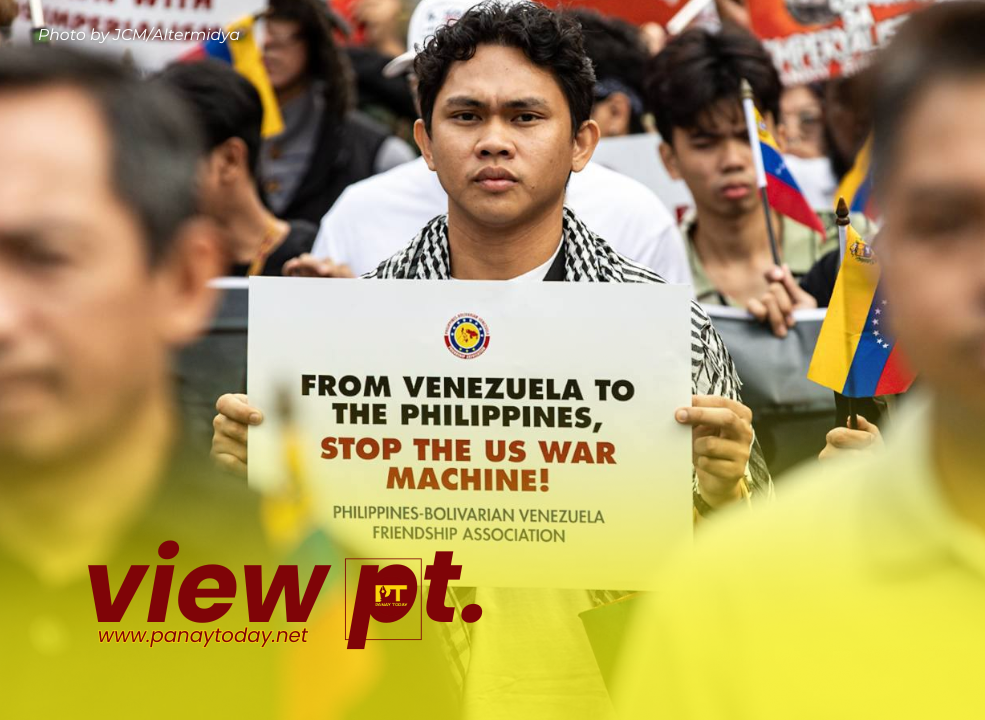
This is where some in the media have failed us. Several Philippine outlets hesitate to feature the massive protests against US aggression, choosing instead to parrot one-sided coverage of a few groups who celebrate the imperialist kidnapping of a duly elected president. Years before this month’s kidnapping by the US, Filipinos have been bombarded with content that presents Venezuela as an economic failure under a “dictator”. This framing disregards the valid bases for Venezuela to cut lopsided relations with big US corporations and leaves out the impacts of the harsh economic sanctions imposed by the US government on the country.
Amid depictions of the Venezuelan economy being in shambles primarily by its own making, we must ask the logical questions: Why do the majority of Venezuelans choose to remain in their country to contribute in building their economy and resisting US intervention? Why have thousands of OFWs flown to Venezuela to work there instead of staying in the Philippines? Why have US military attacks become a greater threat to the jobs of those OFWs than Venezuelan economic policy?
Venezuela’s current economic framework may be imperfect, but we must be cautious by not falling for the notion that the Venezuelan people are blind followers of authoritarian rule. They have an empowered organic movement exerting people power to defend their country’s resources against an empire that uses “free market” rhetoric to mask its economic arm-twisting.
Standing with the freedom-loving people of Venezuela means rejecting passé colonial narratives. We must weigh our sources and refuse to treat imperialist propaganda as equal to the voices of the Venezuelan masses. For Filipinos who love democracy, our duty is clear: support the right of every nation to protect its resources and defend its sovereignty from imperialist aggression.