
 By
By By Juliane Judilla
On the account of some of our colleagues in the media, let us be somewhat critical.
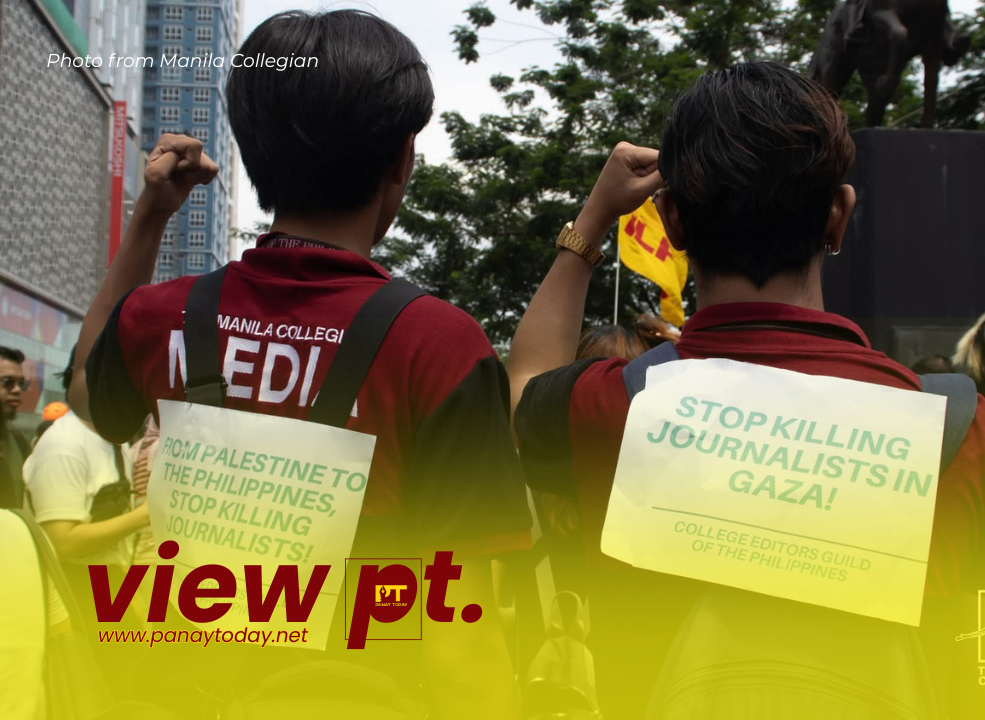
You do not walk and traverse the streets of an occupied land without knowing that Palestinian blood has walked those same paths before you. You do not cross roads, enter buildings, write stories, take photographs, or broadcast from places marked by occupation without remembering that somewhere along those same streets, children have been carried from the rubble; that women have been pulled from beneath the ruins; that journalists, our colleagues, have put on bulletproof vests only to have those vests become their last protection before becoming their caskets.
Long before today’s bombs fell on communities, before children and civilians were buried beneath concrete and dust, Palestine had already been subjected to decades of occupation, displacement, political violence, and dispossession. The language of diplomacy, treaties, declarations, resolutions, and international agreements has repeatedly been used to describe the fate of people whose lives are often absent from the documents themselves.
The history of Israel is, in part, a history of declarations, documents, treaties, resolutions, diplomatic correspondence and international recognition. The State of Israel was declared through a written Declaration of Independence in 1948. Its political existence was subsequently shaped through a long series of international agreements, diplomatic decisions, wars and institutions.
History, after all, is not only made by guns. It is also borne out of language– of words in a paper signed with a pen held by those who seek power.
And yet, some among us continue to participate in efforts to whitewash the bloody walls of occupation—sometimes even through the very institutions that are supposed to inform the public. This includes the use of local media institutions to sanitize narratives, soften realities, and make violence appear distant, complicated, or somehow inevitable.
And this is where writers must ask ourselves a difficult question:
What happens when our words become instruments of erasure?
Borders have been drawn with words. Treaties have been signed with words. Nations have been recognized through words. Wars have been justified through words. Occupation has been rationalized through words.
And words can also be used to make suffering disappear.
This is why the media cannot pretend that writing is neutral simply because ink does not draw blood.
Writers are choosers.
When we choose to write praise for a state while ignoring the people who have been killed, displaced, imprisoned, or forced from their homes, we have made a choice.
When we describe military violence without naming the civilians beneath the rubble, we have made a choice.
When we repeat the language of governments and powerful institutions without questioning whose interests that language serves, we have made a choice.
And when we allow propaganda to enter our newsrooms disguised as objective reporting, we have made a choice.
So we must ask:
For whom do we write?
Do we write for imperial powers whose geopolitical interests are protected while ordinary people pay the price? Do we write for governments and political leaders who speak of peace while supplying, enabling, or defending the machinery of war? Do we write for those sitting in halls of power, insulated from the consequences of the decisions they make?
Do we write for the institutions that demand silence from journalists while journalists themselves are killed on the frontlines? Do we write for the people whose names rarely make it into the headlines, whose homes become coordinates, whose lives become numbers, and whose deaths are explained away as collateral?
These are not merely questions of politics. They are questions of conscience.
Because journalism is not simply the act of putting words on paper. Writing carries power. A headline can humanize or dehumanize. A photograph can expose violence or conceal it. A column can challenge power—or serve it.
We hold the pen in high regard because we understand that words can outlive the people who write them.
And because our words endure, we must be careful about what we choose to preserve.
There is a difference between reporting on power and becoming the voice of power. There is a difference between explaining a conflict and sanitizing it. There is a difference between objectivity and indifference. And there is certainly a difference between telling the truth and repeating the language of those who have the greatest power to define what the truth is supposed to look like.
The journalist’s duty is not to make oppression comfortable for the oppressor.
Our duty is to make reality visible.
We must be willing to write about the dead as human beings, not merely statistics. We must name the displacement. We must remember the history. We must question the language handed to us by governments, militaries, political institutions, and powerful states.
Writers are choosers.
And when history asks what we did with our pens, the answer should not be that we simply become fluent in the language of our oppressors.
It should be that we reported what we saw, questioned what we were told, documented what others wanted forgotten, and wrote for those whose voices had the least power to reach the page.