
 By
By By Juliane Judilla
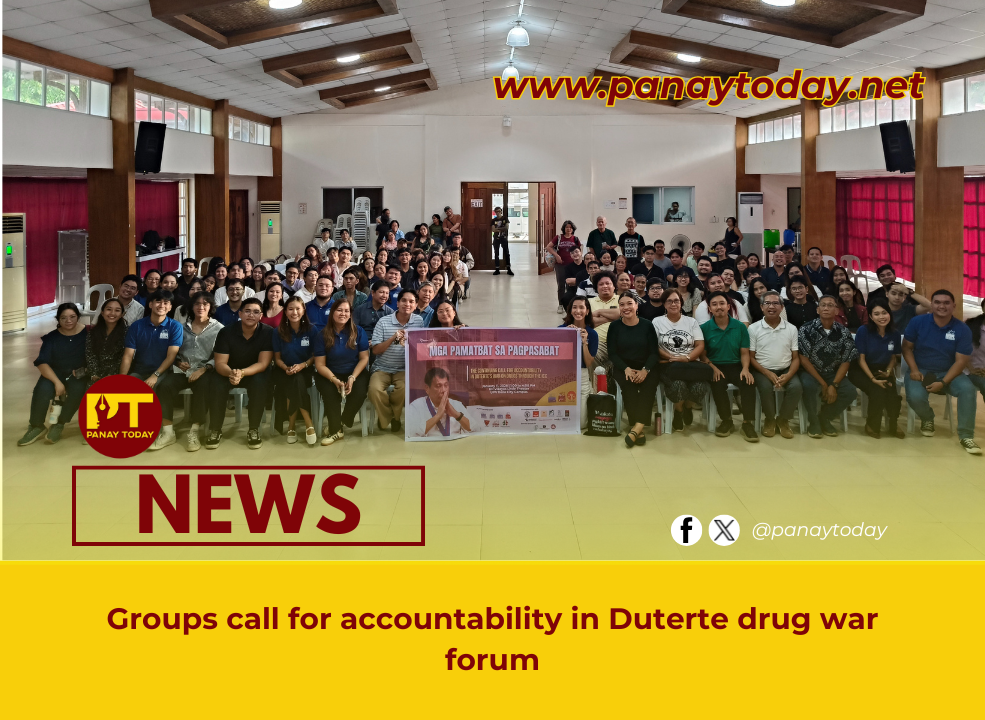
Iloilo City — Lawyers, law students, and human rights advocates gathered on January 11 at the Little Theater of the University of the Philippines Visayas in General Luna, Iloilo City, to reiterate the continuing call for justice and accountability over the charges faced by former president Rodrigo Roa Duterte in connection with his administration’s war on drugs.
The forum, titled “Mga Pamatbat sa Pagpasabat: The Continuing Call for Accountability in Duterte’s War on Drugs through the International Criminal Court,” was led by the National Union of Peoples’ Lawyers (NUPL) Panay Chapter, NUPL Panay Law Students, and the Iloilo Legal Assistance Center (ILAC). Hundreds attended the event, including members of the legal profession, students, and civil society groups.
NUPL Panay Chapter chairperson Atty. Rene Estocapio emphasized that the demand for accountability must persist despite political pressure and resistance.
“Our call, ‘Duterte panagutin,’ is not a mere slogan, but a call grounded on truth, accountability, and principle,” Estocapio said.
NUPL Panay secretary general Atty. Angelo Karlo Guillen discussed the current human rights situation in the Philippines, describing how a culture of impunity was entrenched during Duterte’s presidency.
He said the bloody war on drugs exposed deep flaws in the Philippine justice system.
“War on drugs exposed the true nature of the Philippine justice system. Oppression is systemic. We have the Constitution and the Bill of Rights. We can pretend that these legal protections written on these documents apply to all Filipinos, but that would be a pretension,” Guillen said.
One of the forum’s main speakers, Atty. Kristina Conti, a lawyer for families of victims of the drug war and assistant to counsel at the International Criminal Court (ICC), provided updates on the case of former president Duterte following his arrest and immediate detention in The Hague, Netherlands, on March 14, 2025.
Atty. Conti explained the legal bases for Duterte’s alleged criminal liability under the Rome Statute, citing three grounds:
- Duterte is considered an indirect perpetrator under Article 25(3)(a) as the mastermind and leader of the killings.
- He allegedly ordered and induced others to commit the crimes and aided the killing networks, making him criminally responsible under Article 25(3)(b).
- He allegedly aided and abetted the perpetrators on the ground by providing moral encouragement and other forms of support, falling under Article 25(3)(c).
These allegations, she said, were further supported by testimonies presented during the Quad Committee hearings in the Philippines.
Atty. Conti recalled the testimony of Royima Garma, a former official assigned to the Criminal Investigation and Detection Group (CIDG), who revealed the existence of a “cash reward system” linked to the implementation of the drug war. During the Quad Committee hearing on October 11, 2024, Garma testified that police officers received cash incentives ranging from ₱20,000 to as much as ₱1 million for every drug suspect killed, allegedly upon the orders of Duterte.
Atty. Conti also outlined the next steps in the ICC prosecution, which include:
- Qualification of victims to participate in the proceedings and the appointment of their legal representatives;
- A decision by the Pre-Trial Chamber on Duterte’s fitness to stand trial;
- The rescheduling of the confirmation of charges;
- A ruling by the Appeals Chamber on jurisdictional issues; and
- The continuation and eventual conclusion of the ICC investigation.
According to human rights group Human Rights Watch, more than 12,000 Filipinos were killed in the state-sponsored war on drugs from 2016 to 2022, with at least 2,555 of the killings attributed to the Philippine National Police.
Speakers and participants at the forum stressed that the pursuit of justice for the victims must continue, both locally and internationally, as part of a broader struggle against impunity and human rights violations.